

Say a customer discovers your brand through an Instagram Reel. A week later, they hear your founder on a podcast and visit your site. Three days after that, they click a Google Shopping ad and make their first purchase.
Who gets credit? Instagram served the awareness moment. The podcast drove the first site visit. Google closed the sale. And all three platforms are going to claim that conversion, because the purchase fell within each of their default lookback windows.
In this article, we break down how to figure out which channels are truly driving growth, and which attribution models are most effective for your needs.
What Is Marketing Attribution (and Why Does It Matter)?
Marketing attribution is the process of connecting your marketing spend to outcomes. It uses models to assign credit to the different channels a customer engaged with before converting.
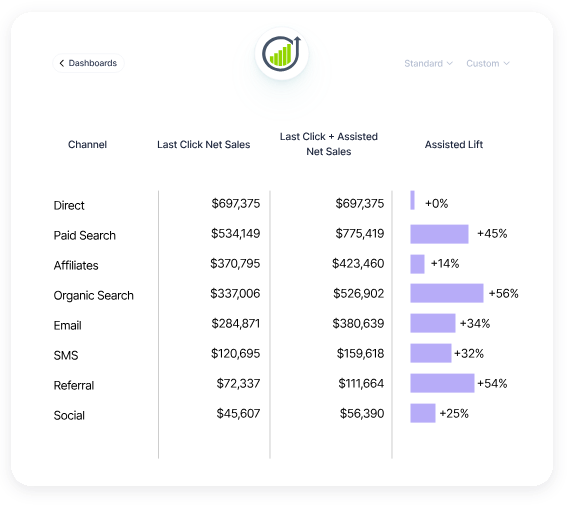
Attribution matters so you know what’s working, and invest in the right channels. Without a sound attribution approach, brands end up in one of two traps:
Either they over-invest in channels that look great on a ROAS basis but aren't actually influencing purchase behavior. Or they under-invest in channels that play a real role in the customer journey but don't get credit because they sit in the middle of the funnel, or are harder to track (think podcasts, influencer partnerships, or organic content).
How Attribution Works & Common Models
An attribution model is a set of rules for dividing credit among the touchpoints in a customer journey. There's no single correct model. The right choice depends on your sales cycle, your channel mix, and the question you're trying to answer. What matters is that you understand what each model tells you, so you can interpret the data in the right context.
Here’s a quick look at the most important attribution models for DTC brands:
The Fundamentals: First-Click, Last-Click, and Vendor-Reported
These are the starting points. First-click assigns all credit to the channel that initially brought a customer to your site. Last-click assigns all credit to the final touchpoint before purchase. Vendor-reported shows you what each ad platform claims it drove.
Pro Tip: Vendor-reported numbers almost always overstate the platform's actual contribution. It's useful input, but should never be the only data you're making budget decisions on.
Assisted Attribution (Multitouch Attribution)
This is where things get more interesting. Daasity's Assisted Attribution, also known as multitouch attribution, assigns full credit to every channel that had a touchpoint prior to purchase, not just the one that got the last click. If a customer touched paid search, email, and organic search before buying, all three channels get credited. (If an order involved a channel more than once, it's only credited once.)
This gives you a much clearer picture of which channels are playing a supporting role in the journey: the ones that don't close the sale but make the sale possible.
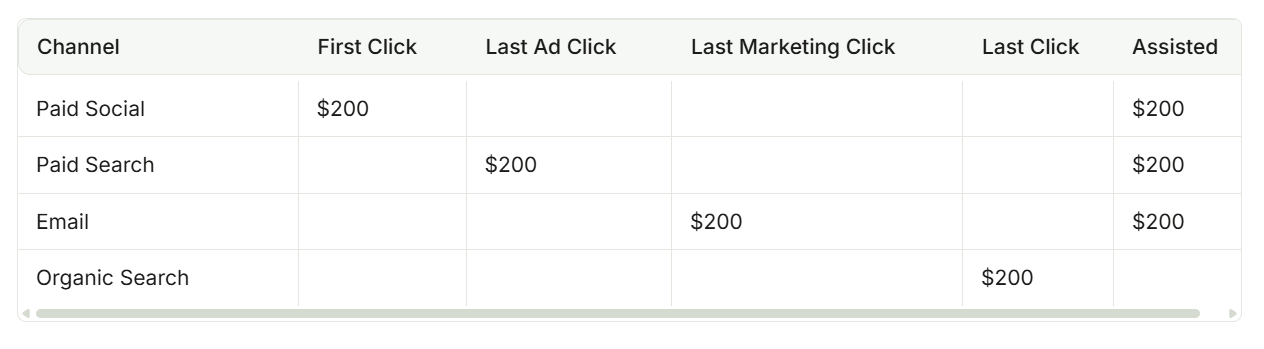
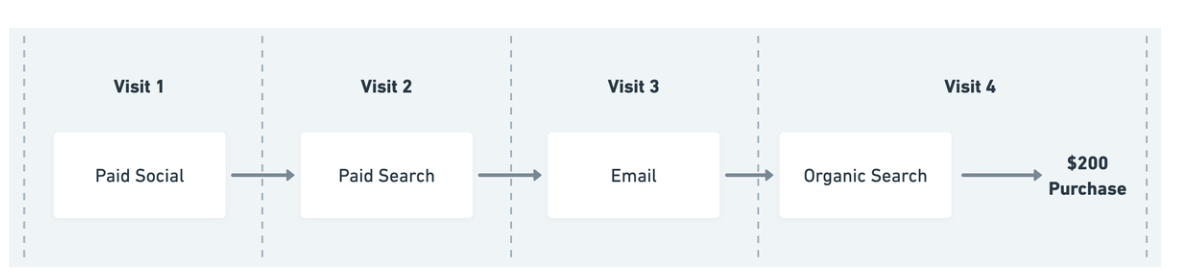
Say a customer visits your site four times before making a $200 purchase: first through paid social, then paid search, then email, then organic search. Under last-click, organic search gets the credit. With assisted attribution, all four channels are credited. Without that view, you'd never know that three of those four channels contributed to the sale.
Last Ad or Marketing Click Attribution
This model filters out non-marketing touchpoints like direct traffic and assigns credit to the last ad or marketing-driven click before purchase. It's useful when you want to isolate the performance of your paid and owned marketing efforts without direct visits clouding the picture.
Survey and Discount Code Attribution
For channels that are inherently difficult to track through click-through data (podcasts, word of mouth, influencer content), Daasity supports attribution through post-purchase surveys and discount codes.
Survey responses (e.g., "How did you hear about us?") help you attribute conversions to awareness channels that don't leave an obvious trail, while unique discount codes tied to specific campaigns, influencers, or channels give you a direct link between a marketing effort and a purchase.
Both are valuable complements to click-based models, especially for brands investing in channels where the impact is real but doesn't always show up in a URL.
If you’d like to dive deeper into the different attribution models, here is a video that walks through them in more detail:
Getting Started with Attribution
An attribution strategy uses data from various sources to determine what is driving sales, including:
- Google Analytics
- Post-purchase surveys
- Discount codes
- Brand data
Google Analytics (GA4) is where most brands start, which provides useful default attribution data. It tracks how customers move through your site, which channels they interact with before purchasing, and offers its own data-driven attribution model. For early-stage brands, that might be enough.
But as you scale, the limitations become clear. GA4 can only see what happens within its own tracking ecosystem. It has limited visibility into channels like podcasts or influencer partnerships, and its attribution models still favor Google's own ad network. It also doesn't connect marketing data to financial metrics like COGS, contribution margin, or LTV.
The real unlock is connecting all of these sources in one place so you can compare channels on a level playing field, using the same models and the same metrics.
How Jones Road Beauty Approaches Marketing Attribution
Cosmetics brand Jones Road Beauty, founded by Bobbi Brown, was investing heavily across Facebook, Google, TikTok, Instagram, and Pinterest, but lacked real-time visibility into which campaigns were actually driving sales.
With Daasity, the marketing team can now adjust campaigns within 24 hours based on contribution margin data, rather than waiting on platform-reported ROAS. Also, their custom attribution analysis helps answer questions like whether ads promoting specific product shades actually increased sales of those colors.
Make Attribution Work for Your Brand
Every dollar you spend on marketing is either building your business or draining it. Attribution is how you tell the difference.
Daasity gives consumer brands multiple attribution models in one dashboard, full visibility across channels (including the ones that are hard to track), and the ability to evaluate performance on the metrics that matter most to your bottom line.
Check out our feature page to learn more about how Daasity can help you fix attribution, or get in touch if you’d like to see it for yourself.
-1.png)


