

Looking for an ecommerce analytics platform that can keep up with your growth?
Maybe you need your Amazon and Shopify data to talk to each other. Maybe you want to share real-time reports with leadership without spending hours compiling data. Or maybe you're just tired of jumping between five different dashboards to get a full picture of your business.
Whatever the case, the right ecommerce analytics platform can make it happen. We've gathered real user ratings, key features, and pricing details to help you find the best fit for your DTC brand. Here's an overview of the best options on the market today.
1. Daasity
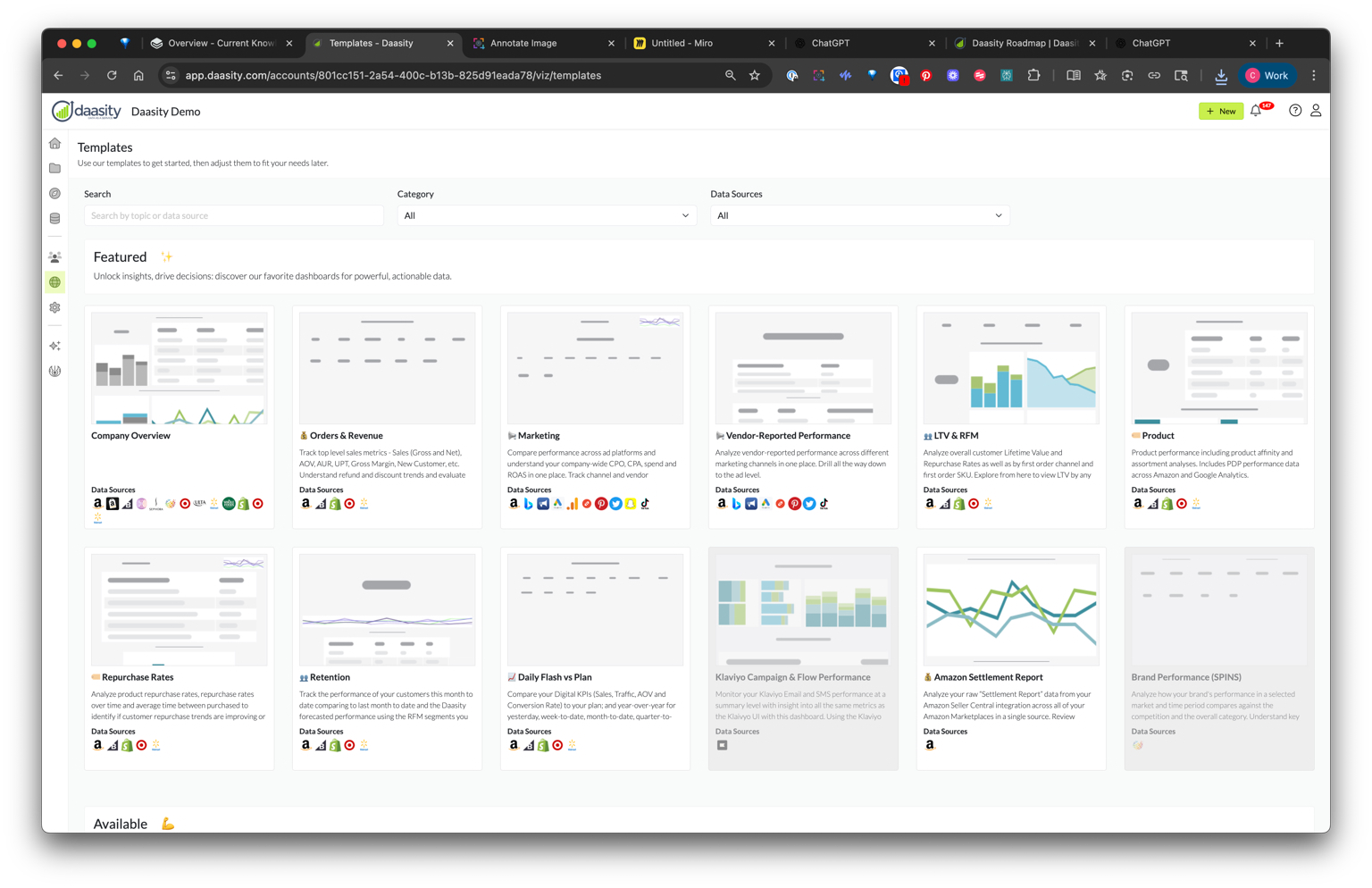
Daasity is an ecommerce and retail analytics platform built for consumer brands by industry leaders who've been in the trenches. It brings all your data across ecommerce, ads, Amazon, and retail into a single source of truth, so you can make faster, smarter decisions without stitching together reports from multiple tools.
Best for: Fast-growing DTC brands that want deeper insights from their data with less effort
Average rating on G2: 4.7/5
Top Features
- Omnichannel data integration that connects your ecommerce, marketing, retail, and inventory data in one unified view
- Product breakdown to track performance across every channel, identify top drivers and underperformers, and make informed decisions on which SKUs to double down on
- LTV by first order to measure long-term customer value by acquisition channel
- RFM analysis to segment and rank customers by recency, frequency, and monetary value, helping you identify your highest-value customers
- Audience segmentation to track cohorts and repeat purchases, and push targeted audiences directly to your marketing channels
- Conversational AI analyst that can instantly answer questions about cross-channel performance
- Promotion predictor that helps brands model campaign impact before committing spend
Pricing: $$$
Integrations: Daasity integrates natively with 65+ tools, including Amazon, Google Ads, Google Analytics, Meta, Klaviyo, Shopify, and TikTok
Daasity vs. Other Tools: Daasity is one of the few platforms that lets you unify your DTC, Amazon, ads, and marketplace data in one place. It offers more integrations than most competitors, making it easy to pull cross-channel insights and optimize your sales, inventory, and marketing strategies.
2. Triple Whale
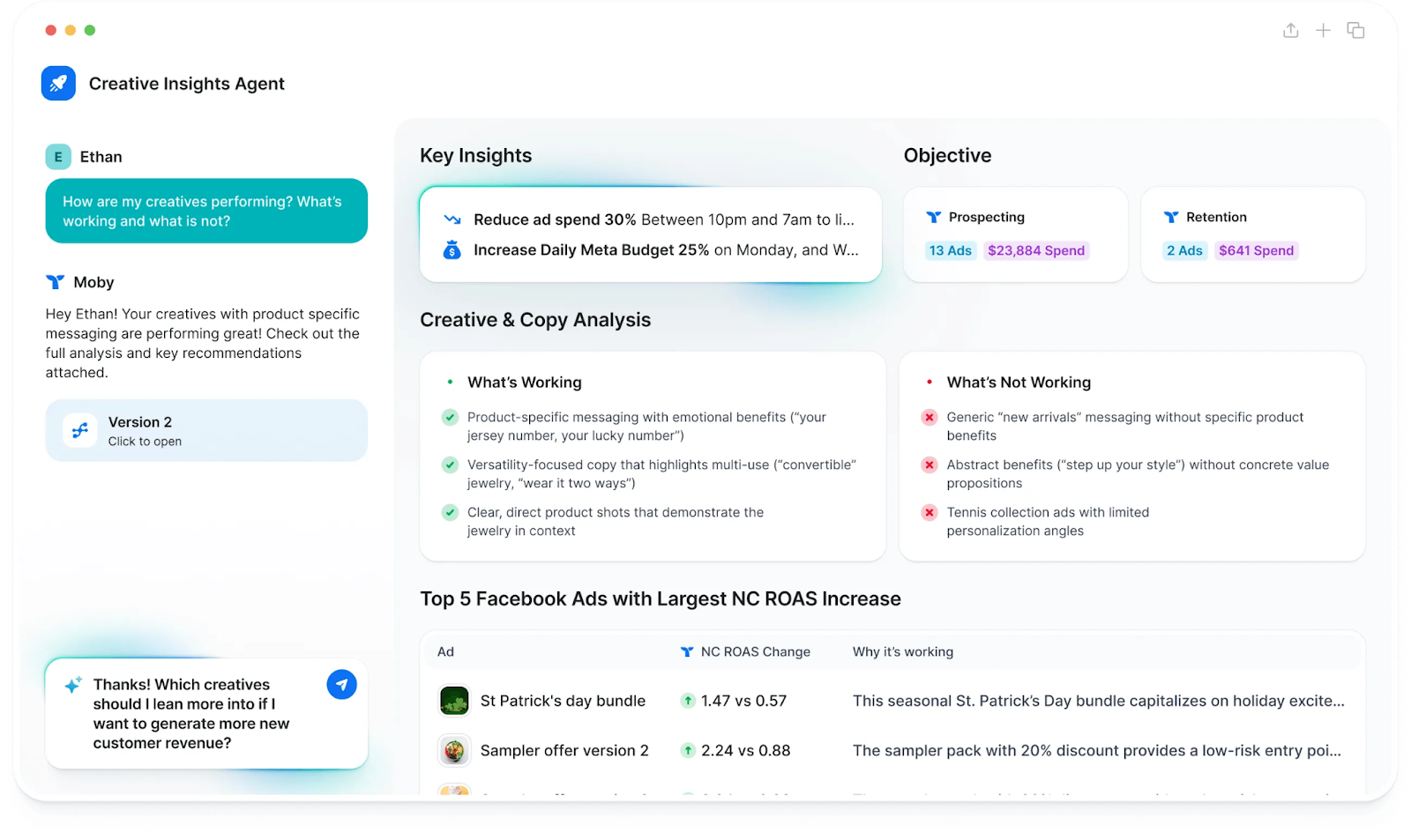
Triple Whale has made a name for itself as the go-to analytics platform for Shopify brands. Its standout feature is Moby, a suite of AI agents that can run analyses, answer data questions in plain language, and generate forecasts on the fly. The platform also includes a managed data warehouse and a full attribution suite, so everything lives under one roof.
Best for: Shopify-first DTC brands that want AI to do the heavy lifting on data analysis and reporting
Average rating on G2: 4.5/5
Top Features
- Moby AI agents to automate analysis across creative performance, customer acquisition, retention, and conversion
- Moby Chat AI data scientist that answers questions in natural language and generates reports and forecasts
- Multi-model attribution suite with pixel tracking, Marketing Mix Modeling, incrementality testing, and identity resolution
- Sonar data enrichment to capture additional customer emails and improve ad targeting
- Fully managed data warehouse that stores all your business data in one place
Pricing: $
Integrations: Triple Whale offers 50+ integrations including Shopify, BigCommerce, WooCommerce, Google Ads, Amazon, and more.
Triple Whale vs. Daasity: Triple Whale excels at AI-powered analytics for Shopify brands. Daasity offers deeper insights across your full business, including finance, operations, merchandising, and retail, making it a better fit for brands scaling beyond pure DTC.
3. Glew.io
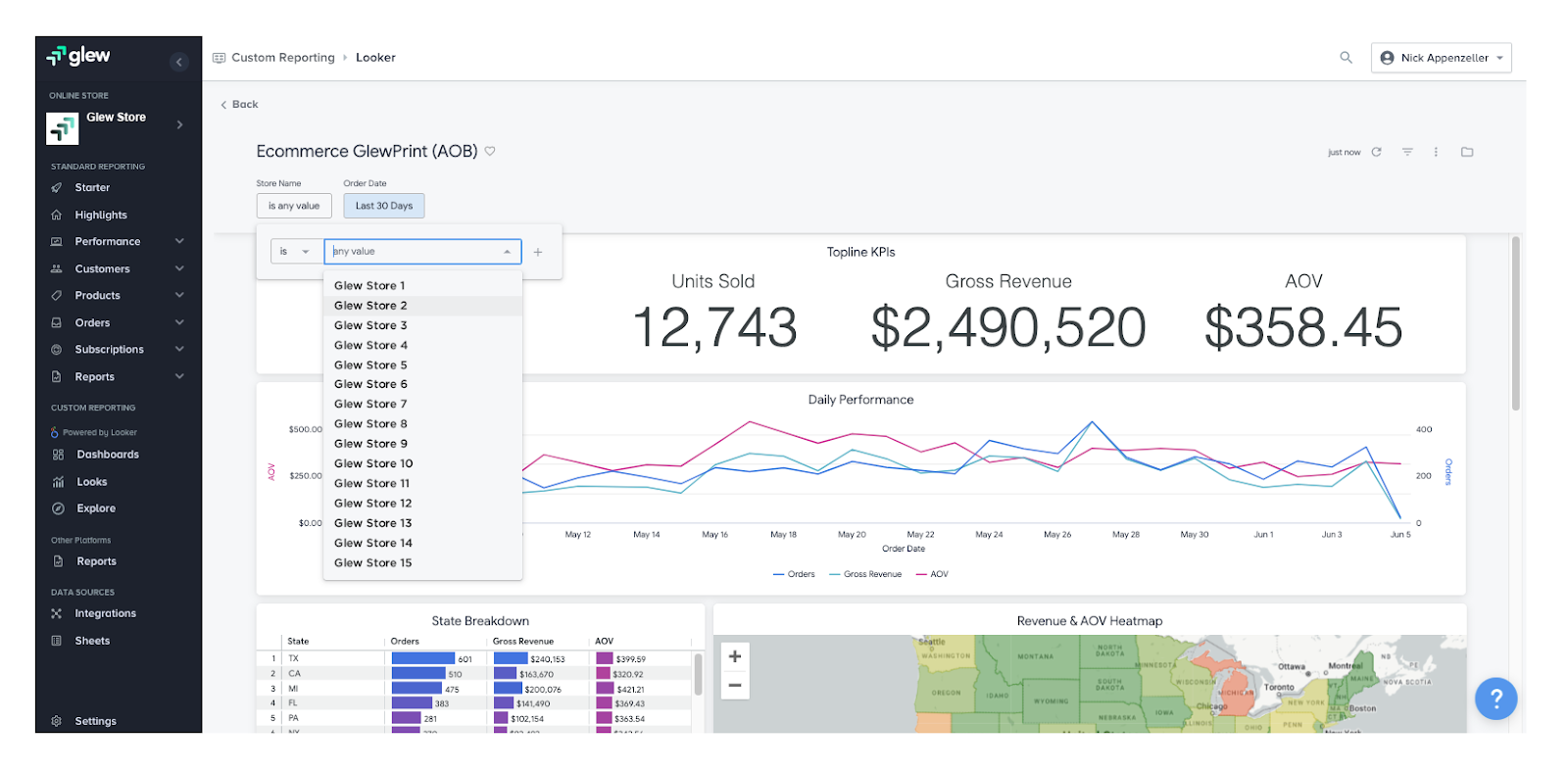
Glew calls itself a "Commerce Data Cloud" and covers the full data journey from ingestion to warehousing to reporting. It's particularly well-suited for businesses managing multiple brands or channels that need everything consolidated in one place. The no-code interface means marketing, finance, and ops teams can build custom reports without relying on engineers.
Best for: Multi-brand merchants and omnichannel retailers looking for a self-serve analytics layer across multiple stores, channels, and platforms
Average rating on G2: 4/5
Top Features
- Automated ETL and data warehouse that extracts, cleans, and organizes data from all your sources
- Multi-brand and omnichannel aggregation to consolidate data across stores, brands, and channels
- No-code custom reporting to create tailored dashboards in just a few clicks
- Department-specific analytics with pre-built solutions for marketing, finance, operations, and merchandising
- Daily Snapshot emails that deliver automated reports with key metrics straight to your inbox
Pricing: Custom
Integrations: 170+ pre-built commerce integrations including Shopify, Amazon, BigCommerce, TikTok Shop, POS systems, and B2B platforms.
Glew vs. Daasity: Glew provides solid omnichannel data aggregation for multi-brand retailers. Daasity adds deeper industry expertise with advanced merchandising analytics, LTV and RFM analysis, and templates built specifically for consumer brands scaling across wholesale and retail.
4. Peel Analytics

Peel is an all-in-one analytics platform for Shopify-focused brands looking to scale. It claims to help them save time looking for data by 80%, and helps non-technical marketers and retention specialists understand customer behavior through AI-powered insights and pre-built templates.
Best for: DTC brands on Shopify looking to improve repeat purchase rates and customer lifetime value
Average rating on G2: 4.5/5
Top Features
- Multi-platform integration across ecommerce, Amazon, and subscription apps
- Hundreds of pre-built DTC dashboard templates ready to use out of the box
- Customer segments that sync with Klaviyo, Facebook, Google Ads, and Google Sheets
- Magic Dash AI retention strategist that lets you ask questions about your data in natural language
- Automated retention analytics to track repurchase rates and subscriber behavior
Pricing: $
Integrations: Peel connects natively with around 20 tools, including Shopify, Amazon, Google Analytics, Google Ads, and Meta
Peel vs. Daasity: Peel does retention analysis really well and is tightly focused on Shopify. Daasity covers the full spectrum of omnichannel data, including POS, email, ads, and marketplaces, and offers more customizable attribution and data transformation.
5. Polar Analytics
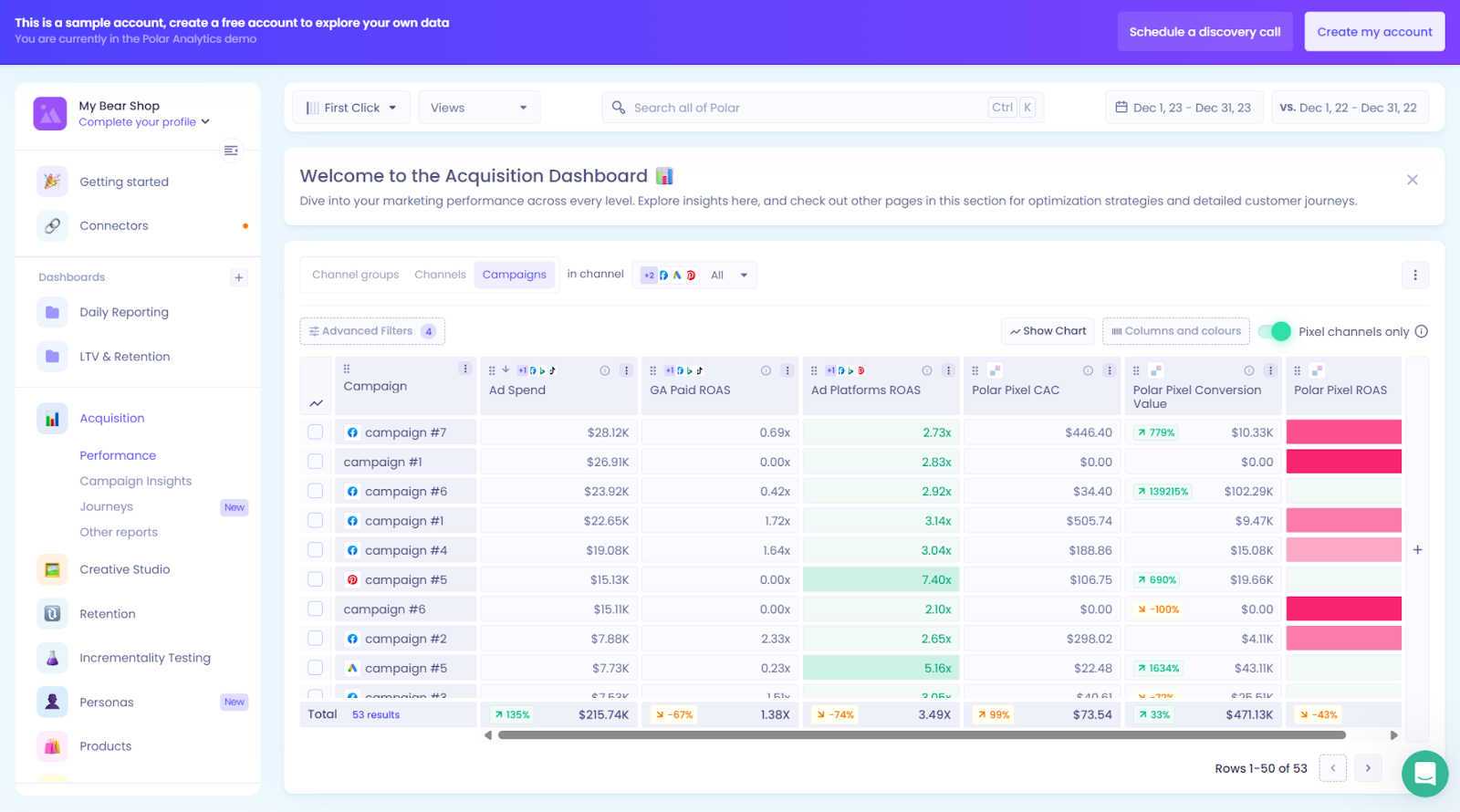
Polar describes itself as the “all-in-one data stack for omnichannel DTC brands.” The platform spins up a dedicated Snowflake data warehouse for each customer, then layers on pre-built dashboards, incrementality testing, and a suite of AI agents that can handle everything from media buying recommendations to inventory planning.
Best for: Shopify-focused brands looking for dashboards, attribution, and AI-powered agents
Average rating on G2: 0/5
Top Features
- Suite of AI assistants for data analysis, media buying, email marketing, and inventory planning
- Pre-built metrics for CAC, LTV, ROAS, cohort analysis, and causal lift testing
- Server-side tracking and conversion APIs with first-party pixel and lifetime ID tracking
- Klaviyo integration to capture missed events and audiences that Klaviyo can't track on its own
- Your own Snowflake data warehouse with 45+ one-click connectors and a semantic layer with hundreds of pre-built metrics
Pricing: $$
Integrations: Polar connects natively with 45+ ecommerce tools, including Shopify, Amazon Seller Central, Google Ads, Meta Ads, Klaviyo, and more.
Polar vs. Daasity: Polar shines in Shopify-centric dashboards and AI agents. Daasity is the stronger choice if you need omnichannel data, deep retail insights, and multiple attribution models across all your channels.
6. Tydo

Tydo positions itself as a customer intelligence platform for ecommerce brands. It pairs a managed data warehouse with AI-driven reporting and 200+ integrations, giving teams access to custom dashboards and insights without needing to build anything from scratch.
Best for: DTC brands that want bespoke reporting and analytics but don't have the in-house technical resources to build it themselves
Average rating on G2: 0/5
Top Features
- Custom data warehouse and reporting with personalized dashboards built for your business
- AI-powered natural language queries so you can ask questions and get instant answers
- Custom attribution modeling to build first-touch, multi-touch, or custom reports and allocate marketing spend with confidence
- Proactive alerts and automated actions across email, Slack, Shopify, and SMS
Pricing: $$$
Integrations: Tydo offers 200+ integrations including Shopify, Amazon, Klaviyo, Facebook Ads, loyalty apps, and more.
Tydo vs. Daasity: Tydo is strong on AI-driven email marketing and custom reporting. Daasity gives you full cross-channel data insight, customizable pipelines, and built-in BI dashboards across your entire business.
7. Northbeam
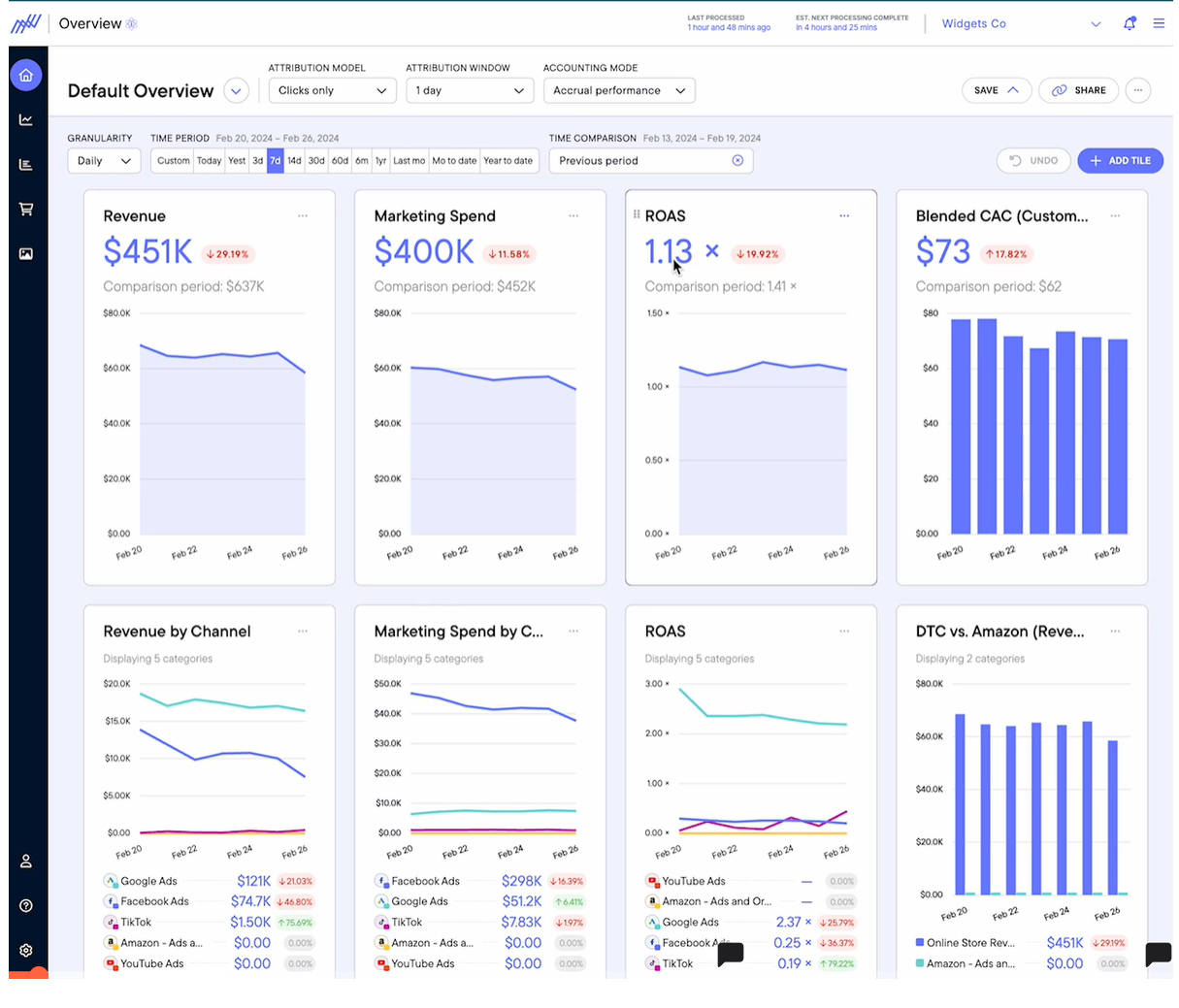
If your biggest question is "where should we be spending our ad budget?", Northbeam is built to answer it. The platform focuses squarely on marketing attribution, using a combination of multi-touch modeling and media mix analysis to map out how customers move from first impression to purchase across your paid channels.
Best for: Performance marketing teams at DTC brands looking to optimize ad spend and reduce waste across channels
Average rating on G2: 4.5/5
Top Features
- Multi-touch attribution with infinite lookback windows to track the complete customer journey
- Media Mix Modeling to create flexible forecasts and budget scenarios
- Deterministic view-through attribution to measure the impact of video and impression-based campaigns
- Northbeam Apex sends attribution data directly to Meta and Google algorithms to improve targeting
- Unbiased ad performance measurement benchmarked against industry standards
Pricing: Custom
Integrations: Northbeam offers 20+ integrations with major ad platforms including Amazon, Meta, Google Ads, TikTok, and more.
Northbeam vs. Daasity: Northbeam specializes in marketing attribution and ad performance. Daasity provides end-to-end analytics across your entire business, including merchandising, inventory, customer cohorts, retail data, and profitability analysis across all channels.
Could Daasity be the Ecommerce Analytics Platform for You?
Daasity makes it easy to unify your omnichannel data and unlocks powerful insights to give your ecommerce brand the edge. We’d love to show you how it works. If you’d like to see Daasity in action and talk about your analytics needs, get in touch.
%20(1).png)


